Following Cases: The Storied (and Violent) Career of the Ruffoni Brothers
August 12, 2026 · Chappy Hall
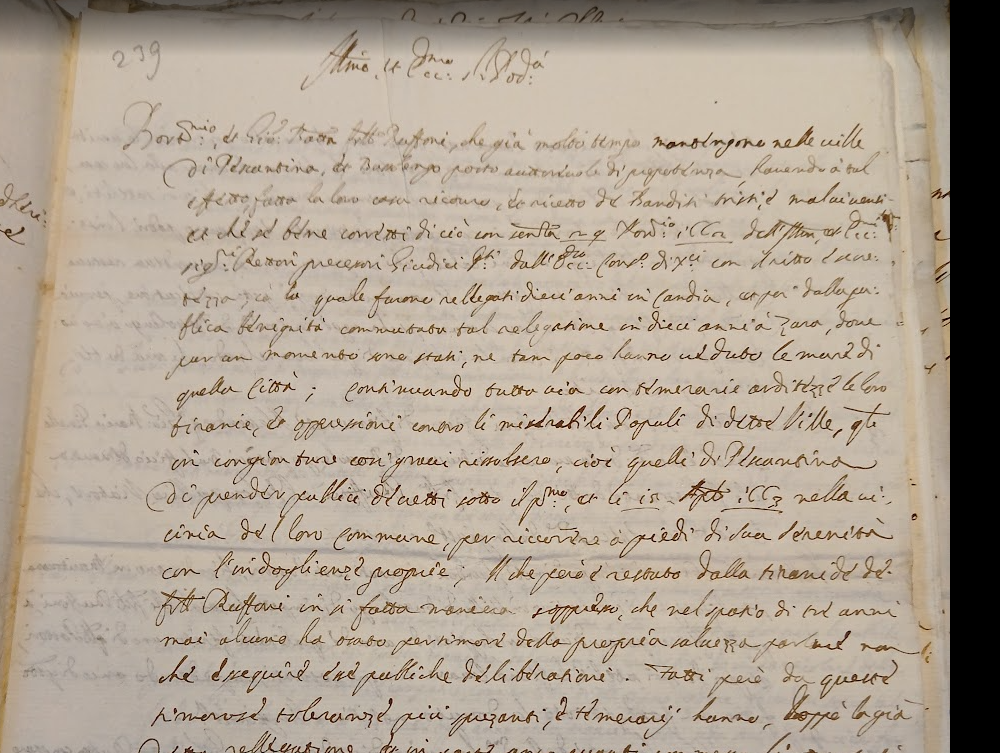
Over the summer, I've processed a lot of data for this project—helping to take the project from 1,000 records to over 6,000. One document describing the murder of an unfortunate Veronese citizen by unknown assassins at night jumped off the page. Here is where I learned about the long-standing tyranny of the Ruffoni brothers. Bartolomeo and Giovanni Battista Ruffoni were men of some standing and influence in mid-seventeenth century Italy. They lorded over and dominated the village of Bussolengo, where their home was located, and the neighboring village of Pescantina for many years. The two villages sit on opposite banks of the Adige River roughly ten miles to the northwest of Verona and at the time were under Veronese, and therefore Venetian, control.
In June of the year 1666 an assault case involving the Ruffoni reached Venice's Council of Ten. On April 12th a man named Gierolamo Massaroli had been beaten and left for dead inside the shop of Bettin Bonifacio in Pescantina. Massaroli's assailants had been none other than Bartolomeo and Giovanni Battista Ruffoni, accompanied by members of their household. According to witnesses, Massaroli, who was a respectable man of good standing, was seated in the shop when the Ruffoni and their party passed by. One servant reportedly observed him adjusting or manipulating his firearm as they passed and, fearing an attack, confronted him. The servant claimed he feared foul play because Massaroli was the nephew of one of the Ruffonis' enemies, Giorgio Fioravanti, who had been imprisoned for attacking them with an arquebus. Certain witnesses alleged that the servant tried to take Massaroli's firearm away from him, that the man physically resisted, and that the altercation attracted the Ruffoni and their other companions, who descended upon the victim. They seized his weapon, smashed it, and then proceeded to brutally beat him with the butts of their own firearms.
Left for dead by his attackers, Massaroli was only able to put forward his own counter-narrative weeks later. He had not provoked the attack but was rather the victim of violent persecution purely on account of his loyalty to his uncle and that man's interests. While this may appear to be a simple case of he said, she said, Massaroli's petition for justice to the Council of Ten reveals that it was nothing of the sort. In fact, this assault was part of a large, enduring web of crimes and violence enacted by the Ruffoni to secure and maintain power in Bussolengo and Pescantina. In addition to a report on this assault case, the Council of Ten was presented with a written brief from Massaroli detailing over a decade's worth of crimes and violence necessitating their intervention.
The written brief accused the Ruffoni of ruling the two villages in a tyrannical fashion. It is unclear when their reign of terror began. The earliest crime recounted in Massaroli's brief is the murder of Domenico Boninga of d'Avesa. On February 13, 1651, alongside armed henchmen, the Ruffoni killed Boninga in the countryside around Pescantina and then mutilated the corpse so that it would not be recognizable, removing one of the victim's feet, which had six toes, before disposing of the corpse in the Adige. Yet outside of this vicious incident the nature of the Ruffonis' other early crimes, and when they began, is unclear.
What is clear is that the Ruffoni were unable to escape the notice of authorities. In addition to the murder of Boninga, which remained hidden, and their tyrannical rule, they were known to harbor banned outlaws and violent criminals in their home. As a result, the Council of Ten convicted them of the latter crimes and sentenced them on August 19, 1654 to ten years in exile. Initially they were to be sent to Crete to serve their banishment, but they successfully had their sentence commuted to a ten-year banishment to Zadar in Croatia. The Ruffoni then immediately committed their next crime as they flagrantly flouted their sentence and remained in Pescantina and Bussolengo, never even traveling to Zadar.
Over the next twelve years they continued oppressing the two villages. In 1662 they assaulted and beat Alessandro Finetto, the Massaro of Bussolengo, to assert their authority. In 1663, a group of shepherds traveling toward Mantua took refuge for the night under the porticoes of San Valentino in Bussolengo, opposite the Ruffoni brothers' house. The brothers launched an assault on the helpless shepherds, subjecting them to withering arquebus fire that badly wounded one of the victims. The Ruffoni then proceeded to extort and rob the shepherds and carried away five of their sheep.
In 1664 the Ruffoni committed numerous crimes against those they held in enmity. Giovanni Battista shot and wounded Pescantina's surgeon Giacomo Rabuesi with an arquebus on the night of the first Sunday of Lent. He then coerced the man into making a false accusation against Antonio Butionino, an enemy of the Ruffoni, in order to protect the Ruffoni. Both brothers were responsible for the death of Giacomo Pinturo of Pescantina that year. Having chased the poor man to the Adige with their gang of hired assassins and retainers, all armed with firearms, he dove into the river and tried to swim to safety. However, he failed to escape and drowned in the attempt. As an additional insult and act of cruelty they also assaulted the poor man's father, Giovanni Barbara, in an armed beating.
These types of persecutions and killings were commonplace among the Ruffonis' crimes, and their attempt on the life of Signor Giacomo Prato in May of 1666 is just one example of how they operated. Initially the brothers hired an assassin named Antonio to murder the man, but Prato survived by killing the assailant in self-defense and then fleeing. In response the Ruffoni pursued him with a host of armed henchmen, including criminals and smugglers, all armed with arquebuses. This hunting party roamed about the area yelling blasphemies and threats while searching for Prato, who only survived thanks to the aid of a peddler who hid him beneath the counter of her stall. The Ruffoni operated through violent force and, when necessary, joined it with public displays of their strength and cruelty in order to induce fear.
Beyond these attacks to exercise power and persecute enemies, the Ruffoni committed many crimes for financial gain. They forced the local peasantry to labor for them while withholding their wages. They prohibited them from working for other employers or with horse-handlers that were not their own. Those who did not comply or resisted were either driven from the area, like Giacomo "Ginardon" Pena, or violently punished. Giovanni Battista assaulted Giovanni Antonio Varino of Bussolengo as punishment for refusing to hand over his home and property to a layman in the employ of the Ruffoni.
The brothers also meddled in government affairs to advance their financial position. They consistently intimidated tax collectors into avoiding them by filling their residence with armed thugs. And not only did they avoid paying their own taxes, they also interfered in wider tax collection in order to seize the money for their own faction's benefit. In May of 1664, they threatened Cristofor Maraggia, the Veronese timber tax collector, with death if he did not transfer the funds and collection of the taxes associated with his office to Giovanni Canovino. Canovino was the Ruffonis' godfather brothers, and in effect they forcibly replaced Maraggia with him in all but name.
While not as striking as these violent crimes, the brothers also illegally processed silk in their house without paying customs dues and sold the silk for high profits in foreign territories. Additionally, they maintained a transport barge on the Adige to facilitate this, and other smuggling operations carried out at night. These illicit activities proved to be financially lucrative for the Ruffoni and their henchmen.
The logical question arising from all of these offenses is how, for many years, the Ruffoni remained entrenched and free to act in Bussolengo and Pescantina. Massaroli's brief points to a simple, but very effective, tactic of witness suppression and intimidation. The coercion of Giacomo Rabuesi into providing false testimony is just one of many examples. In 1663 the inhabitants of Pescantina passed two formal communal decrees on the 1st and 15th of August to present their case against the Ruffoni to the Doge of Venice. However, before the decrees could be enacted upon, the Ruffoni oppressed the people of Pescantina so brutally that for three years not a single word of the decrees or crimes reached higher authorities. To make an example of him, the brothers brutally beat the Massaro of Pescantina, Antonio Giacopini, as punishment for merely performing his duty and routinely summoning the town assembly, since those meetings were where the decrees were ratified by the inhabitants. Massaroli attested that no one even dared speak of the decrees out of terror for their physical safety.
Ecclesiastical and government figures were equally subject to witness suppression and intimidation. In May of 1662, the Ruffoni ordered a mercenary of theirs to attack Father Basilio, the Vice-Prior of Bussolengo's Franciscan Friars, with the express orders to intimidate witnesses. They did so because the Vice-Prior intended to intervene in a criminal dossier being prepared against the Ruffoni in support of witnesses. After he refused a summons, the Ruffoni and their mercenaries ambushed Father Basilio with arquebuses in the street, and he barely escaped death. They then proceeded to threaten the authorities of Bussolengo in an attempt to order the expulsion of the entire order of Franciscan Friars in the village as punishment. When legal documents were successfully prepared against the Ruffoni, they still succeeded in evading them by intimidating public officials who, like tax collectors, did not dare approach their residence, teeming with armed criminals, to serve any warrants.
The outcome of the case brought against the Ruffoni in 1666 is unclear. Further documents detailing a conviction or sentencing may be found as Mapping Violence continues, but it is just as likely those documents have not survived, if they existed in the first place at all. Despite this lack of resolution, the long criminal history of the Ruffoni is still highly informative. Their enduring immunity and flouting of the law point toward a broader trend within the data collected for Mapping Violence so far: witness suppression. The persecution, intimidation, and killing of witnesses is prevalent throughout the violence incidents collated in this project. Furthermore, witnesses who refused to speak out against powerful perpetrators are just as, if not more, common. The nature of this trend, and what it reveals about early modern Italian justice and crime, is therefore a topic of serious interest for focused examination as Mapping Violence continues.