About
Violence in early modern Italy operated simultaneously at the level of the individual encounter and the broader social order. A knife drawn in a Venetian calle, a lawsuit filed before a ducal tribunal, a pardon negotiated through noble intermediaries — these were not isolated incidents but episodes within dense, interconnected webs of conflict, law, and social power. Understanding those webs, and the archive that documents them, requires methods and forms of collaboration that go well beyond what any single researcher can accomplish alone.
Modeling and Mapping Violence in Early Modern Italy, 1500–1700 uses digital methods to study interpersonal violence across the Italian peninsula from the sixteenth through the seventeenth centuries. The project builds datasets from criminal records, court proceedings, pardons, proclamations, and notarial documents; makes that data freely available; and uses computational and spatial tools to analyze patterns across the archive at a scale that traditional methods cannot support.
The Archive and Its Challenges
Early modern Italy generated an extraordinary volume of documentation about crime and violence. Criminal courts across the peninsula produced processi — notarial dossiers containing denunciations, coroners' reports, witness depositions, defense arguments, and final verdicts — that remain among the richest sources available for the study of justice, social order, and everyday life. For the period 1500–1700, many Italian archives preserve these records in considerable numbers. The abundance, however, is deceptive.
Consider the fate of one criminal archive: in the left corner of the reading room at the Archivio di Stato in Venice stands an enormous card catalog — still actively used, still heavily consulted — that serves as one of the primary points of entry into the records of the Avogaria di Comun, including its miscellanea penale. The drawers devoted to this collection contain thousands of handwritten slips, each referencing an early modern criminal case by name, date, and a brief notation of the offense — homicide, assault, insult, infanticide. Tucked at the front of the collection's first drawer, a single slip of paper bears a note in a nineteenth-century hand that translates, roughly, to: I tried. The note captures something essential about working in these archives. The slips it precedes represent only a fraction of the cases once heard before Venice's criminal courts; many more were destroyed during the Napoleonic period or lost over time. What the catalog indexes is not the archive as it was, but the archive as it survived.
That unevenness is characteristic of the broader landscape. Survival has been shaped by the fragile nature of many of these documents and the passage of time, natural disasters, and the reorganization of collections that characterizes any archive of this age and scope. In Venice, most processi from the various criminal courts have not survived, with notable exceptions in the archives of the Terraferma, particularly Verona. In the Estense states, most criminal records from Ferrara and Modena are dispersed or lost, while a substantial body of material survives for the Duchy of Reggio. At the other extreme, Bologna's Tribunale del Torrone preserves more than 10,000 casebooks, filze, and registers spanning nearly three centuries — a collection so vast that comprehensive examination by any single researcher, or even a team, is effectively impossible.
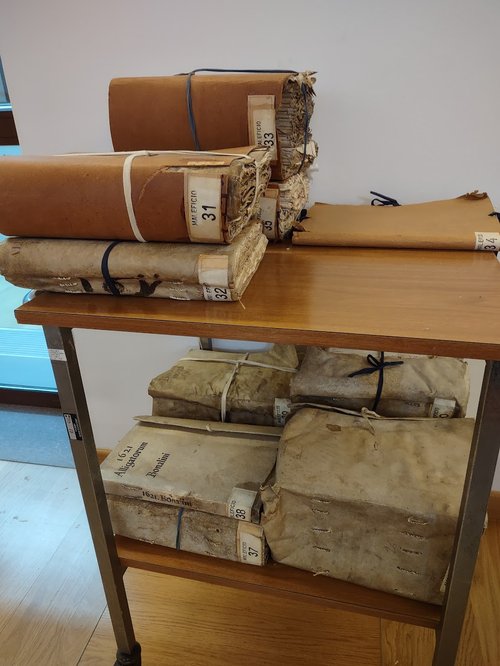
Casebooks from the Giudice del Maleficio, Archivio di Stato, Verona, photograph by Amanda Madden
The result is a patchwork of survival that shapes and constrains the kinds of historical questions that can responsibly be asked. Much of the existing scholarship on crime and violence in early modern Italy has consequently been local in scope, focused on limited chronological windows or on samples drawn from particular years. Even in the most intensively studied archives, only a small fraction of cases have been examined in detail, systematically analyzed, or incorporated into datasets suitable for broader comparison.
There are also relatively few studies that place the criminal courts of different Italian states into sustained comparative dialogue. Did Venetians employ firearms in homicides more frequently than their Florentine counterparts? What can cases involving women — as defendants, victims, or intermediaries — reveal about the variability of gender roles across different legal contexts? Was the apparent rise in violence following the mid-seventeenth-century plague a broader Italian phenomenon, or a more localized pattern? How did different courts calibrate punishment in relation to social status over time? These questions remain largely unanswered, not for want of sources, but because answering them requires working across archives and at a scale that traditional methods make difficult to sustain.
What the Project Does
This project builds infrastructure for the comparative study of interpersonal violence across early modern Italy. We collect, structure, and analyze data drawn from criminal records, court proceedings, pardons, proclamations, and notarial documents, with the aim of producing a resource that supports both close analysis of individual cases and large-scale comparison across tens of thousands of data points spanning multiple jurisdictions, regions, and time periods.
That combination is central to what we are trying to do. The most productive historical scholarship on violence moves between the particular and the panoramic — between the close reading of a single case and the structural patterns that emerge when hundreds of such cases are placed in dialogue. This project is designed to make both registers of inquiry more tractable, and to make the transition between them more visible.
We also recognize that evidence of crime and violence extends well beyond the processi. Chronicles, administrative records, governmental decrees, and other documentary forms preserve substantial information about violence and its social consequences, structured differently from trial dossiers but no less valuable. Several of the datasets developed here draw on these materials precisely because formal trial records are incomplete, unavailable, or have not survived. The archive's absences are not simply obstacles to work around; they are part of the historical problem the project engages.
Violence and Space
A central dimension of the project is spatial analysis. Violence in early modern Italy was deeply embedded in place. Specific streets, courtyards, churches, and market squares appear repeatedly as sites of conflict in the criminal record, and the selection of location was rarely incidental. Churches, for instance, feature with notable frequency in the documentary record, their appearance reflecting both practical circumstance and the symbolic weight such spaces carried within the ritual, political, and communal life of early modern communities.
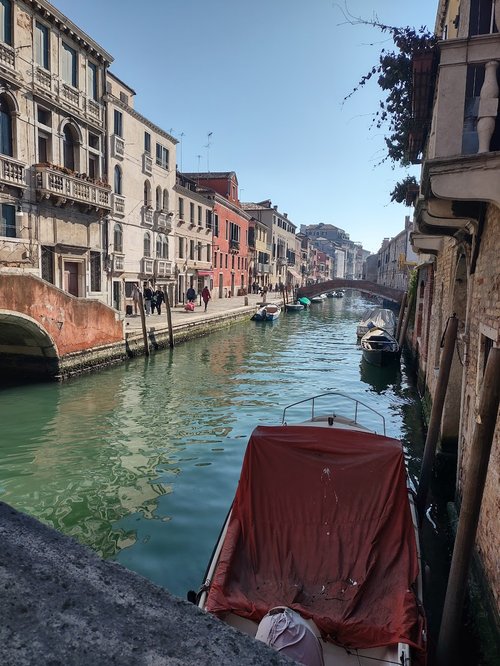
Many of the records we work with include sufficiently precise locational references to permit careful spatial reconstruction, often accompanied by detailed descriptions of the surrounding environment. Using GIS, we map how acts of violence were situated within — and contributed to shaping — the physical and social landscapes of early modern cities. This work surfaces patterns that would otherwise remain dispersed across the archive: where violence clustered, how it moved through urban space, how those patterns shifted over time, and what they reveal about the social geography of conflict.
From Document to Data
Transforming archival materials into structured data raises difficult methodological questions. How can the complexity of a lengthy processus — often running to hundreds of pages of testimony, counter-testimony, and procedural record — be represented without losing what makes it historically meaningful? The same question applies differently to a single-page proclamation, rich in implication but spare in detail.
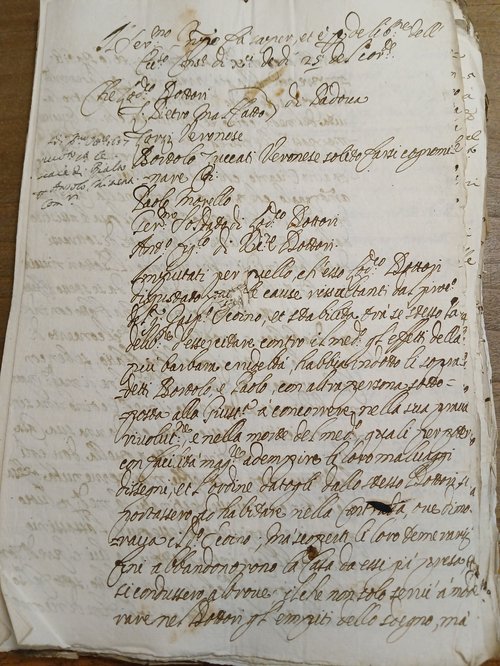
The database underpinning this project is built on a data model designed to capture multiple dimensions of each case: the date and circumstances of an act of violence, the procedural phases of a trial, the sentence and its execution or absence, the demographic characteristics of victims and perpetrators, and the spatial location of the incident. The model continues to evolve as the project scales from thousands to tens of thousands of data points.
Early modern classifications of violence do not map neatly onto modern categories, and the disjunctures matter historically. "Injurious words" — insults and verbal assaults understood as attacks on honor and reputation — were prosecuted as forms of violence even in the absence of physical contact. Infanticide might be grouped under homicide but was frequently treated as a legally and morally distinct category. These ambiguities require interpretive decisions at every stage of data entry, and we document those decisions as part of our commitment to methodological transparency. A fuller account of the data model is available on the Methods page.
What We are Building
Open access. All data produced by this project is made freely available to researchers, scholars, and students. The sources that document crime and violence in early modern Italy illuminate how communities defined justice, authority, and social belonging, and we believe they merit broad accessibility.
Collaborative research. This is a shared research environment designed to grow through contributions from scholars working across institutions, disciplines, and methods — from historians of law and gender to computational social scientists and graduate students building early datasets.
Support for students and early-career scholars. Working in early modern Italian archives presents real challenges, particularly without guidance on the scope and organization of individual collections. Subsequent phases of the project will include research guides to key archival holdings, authored by specialists, intended to provide practical orientation for those entering the field.
Visualization and spatial analysis. We use GIS and related tools to map patterns in the data — tracing the distribution of violence across space and time, its movement through urban environments, and its shifting configurations across the two centuries the project covers.
Why This Work Matters
Understanding violence in early modern Italy — how it was experienced, prosecuted, negotiated, and recorded — sheds light on questions that extend well beyond the sixteenth and seventeenth centuries. The sources this project draws on illuminate how communities calibrated justice, how law mediated social conflict, and how ordinary people navigated institutions of power that were at once coercive and contingent. That archivist's note — I tried — is a reminder of both the fragility of the historical record and the limits of what individual effort can accomplish in the face of sources of this scale. This project proceeds from the premise that systematic, collaborative, and computationally informed approaches to the archive can yield knowledge that neither the solitary researcher nor the card catalog can provide alone: not simply the recovery of individual cases, but a more comprehensive account of the patterns, structures, and meanings that connect them.
For information on contributing data, accessing datasets, or collaborating on research, contact Amanda Madden at amadden8@gmu.edu. For a full account of the project's methodology and data model, visit the [Methods page].